A History Of Penguicon Social Norms
by Matt Arnold
Pre-publication commentary draft as of Tuesday February 17 2026
Penguicon started off in 2003 as a science fiction convention fused with an open source software conference, and blossomed into a convention of all geeky interests. The highest attendance, in the late 2010s, was about 1600. After the pandemic, it was a couple of hundred. For the first time, in 2025, there was no Penguicon. 2026 might be its last year. I'll draw its arc in broad outlines. Changes to technology and the hotel industry are equally important, but can be their own entire essays. A scene is a set of norms. This will chronicle changes to social norms over decades. I will not name specific people, and will not detail the blow-by-blow of the complaints specific individuals have with each other, which were due to our internal differences in conflict-resolution styles.
- Part 1. The Decades
- Part 2. The Long 2000s: Penguicon And Low Stakes
- Part 3. The 2010s: Penguicon And High Stakes
- Part 4. The 2020s: A World Crying Out For Resistance
Part 1. The Decades
To understand the history of Penguicon requires going back a few years, and understanding a period called "The Long Aughts" or "The Long 2000s". It was from 1994 when Netscape Navigator was released, but really got a full head of steam around the turn of the century, when the early-adopters were finding people through the internet who were weird in all the same ways. They began to speak of the information commons a lot. One might call it a time of relative social cohesion for hackers, hipsters, and hippies. The theme was anti-monopoly. The ethos of open-source. The Jargon File. The early blogosphere as it developed norms. Creative Commons licenses. Wikipedia’s founding ethos. Burning Man’s expansion. The indie web. These things all shared a kind-of cohesive ideology, combining a gift economy with self expression. Most important, it combined permissiveness with risk-tolerance.
Into that environment came a 2001 whitepaper titled "Conventions At Light Speed: What Hackers Can Learn From SF Fandom". It's still a great paper, and I recommend you read it. It resulted in the first Penguicon in 2003. That was my first convention, and I immediately got involved, and made Penguicon the central thing I was doing with my life for most of two decades.
It seemed as though every second person I met at Penguicon was carrying a concealed firearm, a root kit, a legal defense fund, and a pocket copy of the Bill Of Rights. Libertarianism was out and proud in a way that it could not be in most other spaces. But the other half of the attendance base felt very different! I've never seen so much interest in socialism or Universal Basic Income anywhere else. (UBI was the topic of a keynote, "Star Trek Economics". I held several panel discussions on it.) That decade felt like the future was open and anything was possible, so people with different norms were able to co-exist for a while, in the hopes that the contradictions would all somehow shake out. We were told that fusing the norms of hackers with that of fandom couldn't work.
The Long 2000s ended with the arrival of social media, which turned hobbyist-friendly technologies into monopolies, closed brands, and walled gardens. Smartphones as a one-way consumption device, and algorithm-driven web 2.0, drove a wave of depression, anxiety, and self-harm. The change to online social dynamics made "The Eternal September" of Usenet in 1993 look like nothing by comparison. "The Long 2000s" mostly collapsed as a cohesive social force in a storm of moral-emotional content and punitive dynamics. I'll discuss in the section on the 2010s how that affected the Penguicon vibe.
It turned out the naysayers were partly wrong and partly right. Wrong that it would collapse immediately, and right that it eventually would undergo a stark shift, characterized by a collapse of internal trust among the convention organizers and attendees. Again, I won't mention anyone by name or go into the detailed blow-by-blow here.
For the next bit, I'm going to put on a different hat. I'll speak on behalf of the spirit of that decade, and I'll advocate for decisions you might not agree with, as though we are in 2003. But we're not. It was very much of its time. You're going to want to protest that conditions in the 2020s are different. Technology, the economy, the hotel industry, and common norms have changed. But I hope you just understand why Penguicon was able to succeed in the first place, even if you think it was an unsustainable dream.
So here goes. I'm putting on that perspective starting ... now.
Part 2. The Long 2000s: Penguicon And Low Stakes
There was another time when we didn't know if there would be another Penguicon: the first Penguicon.
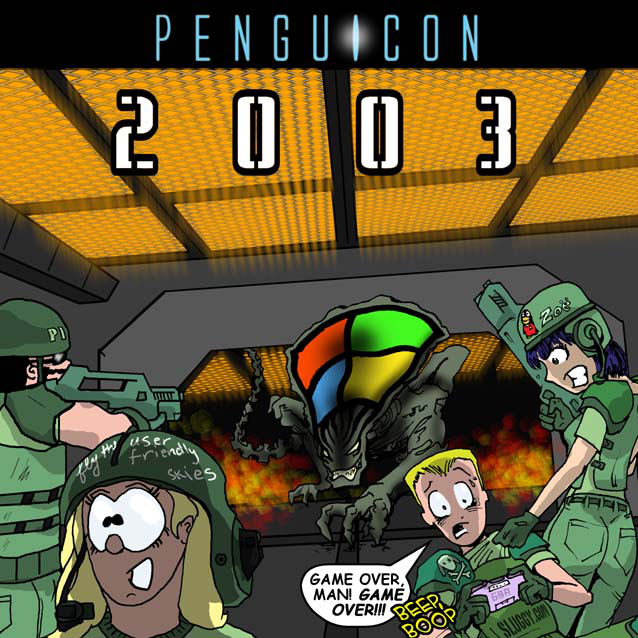
At the first Penguicon, bad news: it's game over! But good news: it's game over!
Penguicon started because ConFusion had gotten too risk-averse, and the other convention held in the spring, ConTraption, had died off completely. What made ConFusion start to decline at the turn of the century, and Penguicon take away most of its oxygen, was Penguicon's willingness to risk its own bankruptcy and dissolution, and ConFusion was covering their ass. ConFusion had a bank account and a lot of name recognition which drew attendees. They had something to lose. The upstart had nothing to lose.
A bunch of rebels struck out on their own with a vision to let people do good things for themselves and each other and get out of their way. They were people who start things, so if the whole thing crashed and burned, the same people could start something else. It's better for the event to come to an end having done something wonderful, than to prevent risk by saying "no" to the ways attendees want to provide value to each other. This resulted in a massively participatory scene.
We were inspired by an era in which open-source hackers voided warranties in order to escape control by big tech, and fans wrote fan fiction without asking permission first. In that spirit, we had a mascot and logo, Starfleet Tux, who was a mashup of intellectual property owned by two other corporations. We should not have changed it to a new logo.
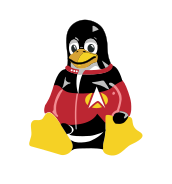
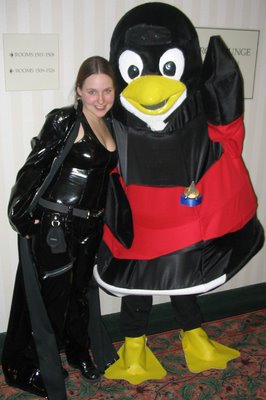
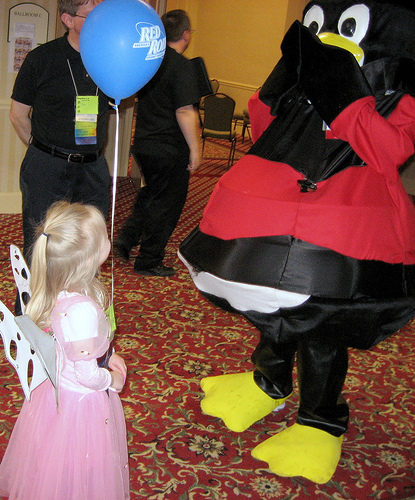
The new 2011 logo.
(Tux wasn't in Starfleet. Tux was dressed as a fan. What does this have to do with open source software? Because fandom, too, created all-volunteer not-for-profit projects: fan-run conventions.)
Bear in mind this was post-nine-eleven, "if you see something, say something," a paranoid time when you could get in trouble for flash mobs or alternate reality games. Real safety is empowering ourselves and each other to get better at danger. Instead, "safety" was used to mean "control". The normies were spooked by anything that was in any way surprising, unexpected, or not under top-down control. In the wider culture, it looked like the death of all adventure, but the culture of Penguicon centered around risk-tolerance and permissiveness. We had a lot of arguments in which I kept saying to other organizers and attendees, "don't let the terrorists win". This was the decade in which, when I said that, it worked.
All of the things we did were in the spirit of Do-It-Yourself, without mediation from entertainment conglomerates, big tech, and nationalized hotel chains (a big part of our success was the flexibility that chains used to give to management of their individual hotels, to make deals to increase their business). It resembled what theorist Hakim Bey named a "Temporary Autonomous Zone": a deliberately ephemeral gathering which found an overlooked space for self-determination, and dissolved before it could be absorbed by institutions or calcify into one. As a result, some things at Penguicon challenged conventional wisdom. Here they are in a list.
-
We had the aforementioned logo which used IP from two other institutions who were known to be pretty lenient with their fans.
-
We served a keg of beer in the Consuite. Even though we were carding everyone, some thought it was potentially a legal grey area.
-
Some people showed each other movies and anime with no regards to licensing.
-
Attendees routinely got naked in the hot tubs and the pool. (No one would have done this if we had not sold out the whole hotel.)
-
A swordfighting group dressed participants in body armor and gave them fake semi-automatic weapons with orange tips to show they were fake, and staged something like a SWAT entry simulation exercise in selected hotel rooms. They literally rappelled from the balconies.
-
Most famously, we made ice cream with liquid nitrogen, which is about as dangerous as boiling water on your stove, but people were quite afraid of it at first. When we were done, we would throw the leftover liquid nitrogen into the swimming pools, producing a huge billow of steam. The first time we did this, I immediately put the video on my YouTube channel. Because of this, I have more than a thousand subscribers. The video has eleven million, seven hundred thousand, five hundred and eleven views. The vast majority of the five thousand plus comments are telling us we must be out of our minds.
-
At first we did not have, or want, event insurance. Again, if the event fails, the LLC soaks it up and collapses, which is why LLC stands for limited liability corporation. (You can tell me you don't believe you're individually protected, but remember, I'm putting on the perspective as if it's 2003. In that decade, I frequently heard about not being able to "pierce the corporate veil".)
-
We were able to offer 24-hour consuite (a hospitality suite full of complementary snacks and couches, with a bathtub full of ice and complementary canned drinks), because we did not yet post someone to supervise inside it. We only posted someone to check badges outside of consuite because it was a cost center, but once you were in, there was no babysitter. Likewise, we did not yet put anyone in the board game room to supervise board gamers. I routinely left my entire board game collection unsupervised on a table and got it back at the end of the weekend. We acted like attendees could be trusted even if they sometimes can't. This has a huge effect on people feeling like they're trusted, and that they're attending a convention with generally trustworthy attendees.
-
Penguicon was not for self-infantilized people. We considered attendees to be full adults capable of adulting, and if they were not, that sounds like a you problem. We did not consider them to need organizers to serve as unpaid law enforcement, investigative journalism, jury duty, emotional counseling, mediation ... and hell, sometimes even a touch of crisis management and suicide watch now and then. In the 2010s we started getting grown adults rocking back and forth in the fetal position in an elevator lobby, or discovered in a dissociative fugue state in a stairwell. We should ask them not come back next year unless they bring someone to be their caretaker who never lets them out of their sight. But that's talking about the 2010s, so I'm getting ahead of myself.
We were not able to find a way to get around the pressures for us to change many of those. But we proactively and voluntarily overturned the rest of them to cover our asses. We are now in the risk-averse place ConFusion was when Penguicon took over from it. And we are probably about to be in the place ConTraption was: stepping aside for what's next.
Self-determination, self-reliance, liking who you are, starting something new, and taking risks responsibly, are partially just aspirational qualities, which we only partially achieve in reality. But we must aspire to them. Otherwise, we may as well just attend corporate-run conventions that treat us like children. That also would mean, there would be two levels. At the top level, for-profit conventions have professionalized staff, who are employees. They are treated as trustworthy authorities, and we attendees are not. We are there to contribute only money, and they are only there to get paid money, and so, they are the only ones who need to do work. We're passive consumers. A convention of engaged participants and co-creators goes hand-in-hand with a gift economy. A gift economy withers away when there is professionalization.
Perhaps someone can say that convention attendees cannot be trusted! And they might be right. But that disproves and refutes the Penguicon experiment which caused our original explosion of engaged participation. You can advocate to change what Penguicon is, but I'm asking you, please, don't sanewash it to flush it down the memory hole, as though we always played it safe.
Taking my 2000s perspective off, and putting my 2010s perspective on... now.
Part 3. The 2010s: Penguicon And High Stakes
The Early Twenty-Teens: The Geeks Inherit The Earth
I was libertarian in 2003, and by the 2010s, I was not. I noticed those who show up to help do the work are motivated by a communalist attitude. I heard rugged individualists talking a big game, but they didn't put in the work. If you want to own your computer instead Big Tech owning it, it takes work. If you want to own your convention, it takes work. Not just talk.
Penguicon started out with a lot of well-specified strong sub-pieces held together by an ethos (which I described above). Over and over, the leadership stated a deliberate intention to never say "you can't present about that here". It turns out, when you open those floodgates, it slowly transforms into a vaguely-fuzzy monoculture which doesn't know what, if anything, holds it together.
I would often describe Penguicon the way I did in the 2000s section of this blog post. But it was increasingly inaccurate. If you want to attend an event in order to talk about the issues of the Electronic Frontier Foundation, and you attended Penguicon in the mid-to-late 2010s, you might look around and ask yourself, "this is fine, but why did I choose to come here instead of somewhere more specific?" This is a result of our success. The geeks inherited the earth. An event for everybody isn't an event for anyone in particular. A lot of the open-source technology talks drifted away like the elves leaving Middle Earth. It's been a long time since there was a significant tech presence at Penguicon, even though it's technically inspired by open-source software. How did that happen? Part of that was a change in the overall society. We won. Geekiness was the safe and normalized pop-culture mainstream, so what need was there to go to a convention? (The answer is, you go for the permissiveness and risk tolerance.) This was accompanied by a society-wide decline of deviance.
The Early-To-Mid-Twenty-Teens: The First Wave Of Misanthropic Edgelords
I wish I could end the 2010s section here.
During its first decade, Penguicon had its share of zealots, but their perceived villains were things like Microsoft or the RIAA or DMCA. It wasn't each other.
Penguicon went through two very different waves of overly-online radicalized edgelords in the 2010s. Each wave seemed to gain strength from group membership in a shared grievance, far more than membership in fandom at large. To maintain their membership in their radicalized subculture, they had to feel futility that their concerns could be addressed. If you thought there was hope, you would be cast out of the group of edgelords, as a milktoast compromiser.
Let's start with the group that later came to be called "the alt-right". No sooner had the majority of Americans gotten on social media around 2012, these young men began to impose seemingly-endless social media moderation work on Penguicon. This faction seemed incapable of participating in a disagreement with anything other than implicit insults and implicit threats. Vitriol was used as a first resort.
Within a few years, there was gamergate, which you almost certainly know about. Then there was the Sad Puppies and Rabid Puppies campaign to do ballot-stuffing on the Hugo Awards. A few of them just wanted to get some more conservatively-oriented stories and novels onto the slate. But soon, the prevailing popular strategy among those who participated was to make the entire slate of award nominations into works that would lose to "no award", in order to ruin that year's Hugos for everyone as retaliation.
Attacking our most important awards makes one thing clear to everyone: that you no longer consider yourself part of our community and do not wish to be.
This began a slow but steady landslide of guilt by association. Soon, central members of the community, who had set the tone for our social norms ever since the founding, who were various levels of conservative, both large-C and small-c, very publicly ended their involvement in Penguicon.
At that point, you could not have conservative leanings in fandom at all. To be clear, I personally have voted straight-ticket Democrat my entire adult life, and I had just endured years of abuse as a social media moderator where exactly one side acted out performative cruelty while a broad coalition of others with various political perspectives unified against them to be calm and reasonable. I know plenty of reasonable conservatives, but where were they lately? The only "conservatives" we seemed to attract now wanted to burn everything down! We started seeing public posts about plans to sabotage Penguicon while wearing full-body costumes to hide their identities. At the time, I thought, good fucking riddance.
I was not thinking through what was going to happen when fandom became fully unified about who to hate.
The Late Twenty-Teens: The Second Wave Of Misanthropic Edgelords
It's been said that the farther you get to the extremes of the political spectrum, the more you have in common with the other farthest extreme, and the less you have in common with the non-radicalized. The spectrum is curved to bring them together like the tips of a horseshoe.
After the Sad Puppies debacle, cruelty in fandom could happen with impunity if the motive was that it would make the alt-right angry that we're treating each other with militance and a stance of groveling apology. Anyone who tried to speak up and say "hey, cruelty to each other is actually never the answer", would, themselves, be shouted down. The fiction publishing industry came to seem like an endless stream of moral panics on social media. The edgelords were no longer the outsiders; routinely, they were fiction authors presenting on panel discussions. During the previous wave, members of the alt-right had given me what, at the time, sounded like absurd paranoid fantasies about how the majority of us would be supposedly driven out for insufficient political zeal. I was flabbergasted when, in the late 2010s, those stories started to come true. I felt like I was going crazy. Nobody credible tells those stories, or would believe me if I told them.
Several people associated with Penguicon, who, years before, were sympathetic to the alt-right, now flipped their political valence to the opposite. When a person wants to emulate a Batman villain such as The Joker, they have no actual ideals. During the final years of the 2010s, they began a campaign of sabotage, death threats, stalking at people's homes, and intimidation, against the organizers. That story ends in an incarceration.
We could not stand up to them as easily as we could stand up to the alt-right, because the story the public was ready to believe, was that convention fandom was a cesspool of oppressors and abusers. All that a bad-faith actor has to do, is commit misconduct and sabotage, then tell that story to the public in their defense, and the wisest and most stable among us are not sure who to believe, while the most emotionally-reactive Penguicon attendees on social media amplify a false narrative without question. Some of the most valuable Penguicon organizers had always been neurodivergent, traumatized, or disabled, and in the late 2010s the language of those important concepts were being constantly misappropriated by cynical opportunists.
I was given more reason to feel fear for utter social exclusion from my community, as well as for my physical safety, than I ever had from the alt-right.
Trust evaporated. We started tripping over each other's feet because we were keeping secrets. Organizers started shutting out other organizers from crucial information, often preventing them from performing their job functions. This is because there were credible threats of murders that supposedly were planned to occur at Penguicon during the convention, and very few could feel sure which volunteers were secret accomplices. In the 2000s, organizers had monthly social gatherings, and routinely went out to eat with each other after convention committee meetings, and got to know each other, building trust which would have solved this. Ten years later, offline connections had been long gone.
Throughout the mid-to-late twenty-teens, it became more and more difficult for me to continue to describe "what is Penguicon" and have it still be an accurate description of what you would experience. For example, hundreds of times, I told people "if you want to provide value to other people in some form at Penguicon, and you're not causing anyone any problems, it's really hard for anybody to stop you." That became gradually less true as we took on a "see something, say something" set of norms. It was reminiscent of the post-nine-eleven social norms Penguicon had so vigorously opposed from the beginning.
The Loss Of Madcap Penguins In Our Symbolic Imaginary
In 2004, two attendees wore intentionally-paired costumes: one wore a blue butterfly costume (the logo of Microsoft at the time), and the other wore the Starfleet Tux mascot costume, chasing his friend through opening ceremonies with an oversized flyswatter. A writeup of Penguicon once wrote admiringly that the Starfleet Tux mascot contrasted powerfully against a Mickey Mouse corporate mascot, describing Tux as something like "running around unauthorized and off the leash". Starfleet Tux was an "imago": an image or template that activates the unconscious and can engage your personal mythology. Part of the mythology here is that by joining together, we can solve our own problems.
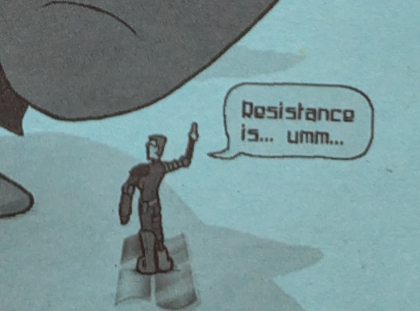
You can see a transformation in symbolic forms such as the cartoon representations of penguins. In the 2000s, the covers of our souvenir books showed a lot of cartoon penguins committing cartoon acts of violence.
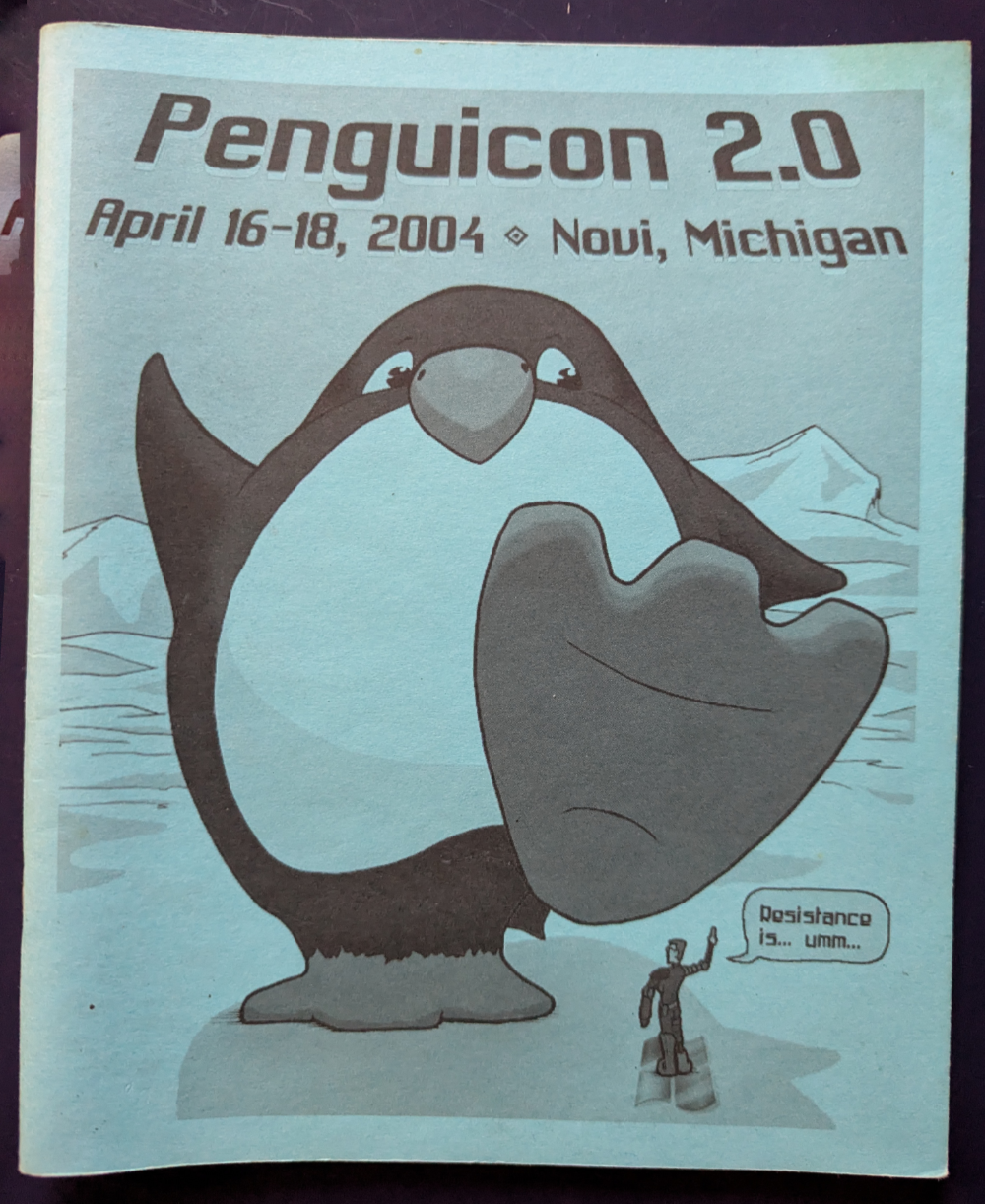
A Penguicon 2004 schedule book cover by Howard Tayler, depicting a giant Linux penguin about to step on Microsoft's Bill Gates who is dressed as the Borg from Star Trek, who is saying "Resistance is... umm..."
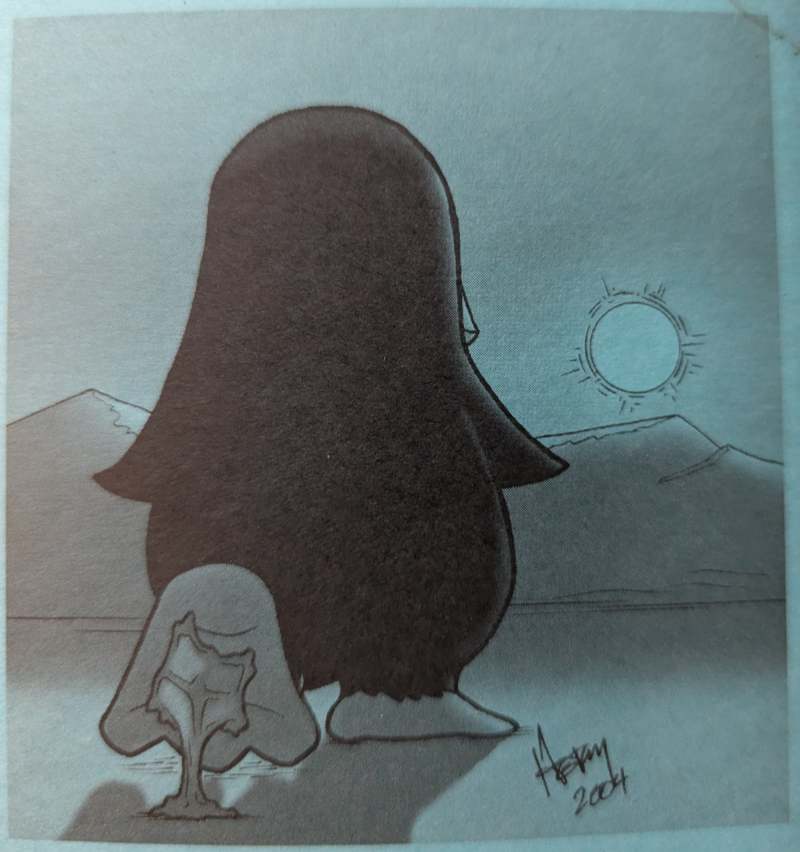
Detail of part of the back cover of the Penguicon 2004 schedule book. Illustration by Howard Tayler, depicting the giant Linux penguin from the front cover illustration, walking away, leaving behind sticky wad under its foot in the shape of a Microsoft Windows logo.
Or the penguins are being boozy, singing karaoke, or engaged in a variety of intense challenges like swords or jetpacks. The style seemed to resemble that of troublemaking trickster-deities like Bugs Bunny, suitable for animation for adult audiences such as Looney Tunes.
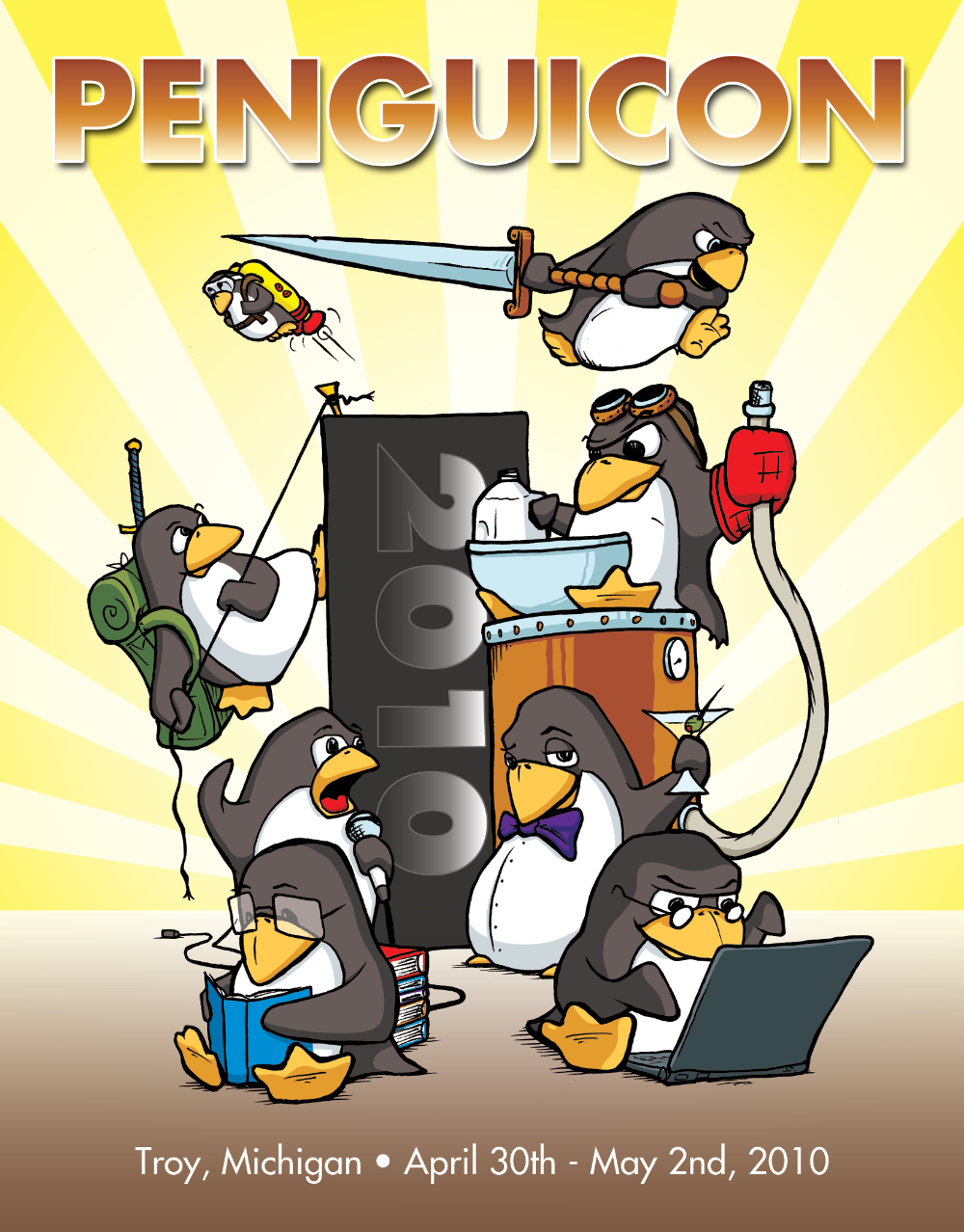
A Penguicon 2010 souvenir book cover by Howard Tayler, depicting cartoon penguins jet-packing, swinging a sword, concentrating intensely on a book or on a laptop, singing karaoke, drinking a martini, and pouring liquid nitrogen into milk to make ice cream.
Throughout the 2010s, the penguins started looking infantilized, like they are for a five-year-old audience. One such illustration was literally Care Bear penguins engaged in a Care Bear Stare. The prototypical Penguicon participant was assumed to be afraid, incapable, in need of protection and care. In need of safety through controlling others, which is the opposite of an environment of risk-tolerance, permissiveness, and trust. In need of an authority to manage risk for them. The loss of madcap penguins is a seemingly-irrelevant detail, but it indicated a real shift in attitudes.
By this time, fandom was now more-or-less the same thing as online fandoms. Here's what that means. There are very few "walls", metaphorically, on the monopoly social media platforms. It's decontextualized hypervisibility, the opposite of a Hakim Bey's Temporary Autonomous Zone. It's a "panopticon", all one room, where every person is on a stage, with a spotlight and a microphone. Without walls, performances attract audiences, and audiences transform everyone into a performer. Our brains normally subtly switch our behavior because we are picking up on context clues. The mere existence of the public watching, exerts a subtle influence on every interaction to turn it into highly emotionally-charged winning and losing contexts.
Harm and danger are the most powerful argument that can over-rule any other consideration. And so everything becomes about preventing harm and danger (contrasted with the ambitions and desires of which early Penguicon was an expression). On social media, the only way to respond to help with harm and danger is not through physical violence, but through social attack as an expression of care (hence the Care Bears). A social media pile-on is a cheap and meaningless form of care which risks nothing and costs one's self nothing. It costs the social scene everything.
This is a panopticon, in which the salient factor about every person becomes their medicalized woundedness; we get classified as a harm-doer, and a victim of harm-doers, simultaneously. Monopolistic culture-producing corporations cashed in on these anxieties for market share. Culture creators ended up with the downside. This messaging from institutions then fed back into the online groups centered around those interests, contributing to increasing instability. Culture-producing monopolistic institutions increasingly adopted their audience's medicalization framework, in which, when we feel uncomfortable, we call that "unsafe".
It turned out the same lesson that applies to the libertarians who didn't put in the work to make Penguicon their own, but liked to complain about not feeling at home there, also applied to those who identified with the penguin Care Bears. It turns out if you want to have a voice in a group, actually exercising that voice takes spoons. During the 2000s we elevated and prioritized those who said (correctly or not) they could do great things competently. In the late-2010s and onward, we elevated and prioritized whoever had inabilities, at the expense of those contributing to the group. Surely there's a third way.
I made many of the arguments in this essay for years, in one-on-one conversations, and got nowhere. I seemed to be alone in saying "There is a thing that Penguicon is. Sure, it's nebulous, but it's not everything, and it's not nothing." This is culture-building, which is distinct from top-down control in that it has to work bottom-up in one-on-one conversations. It only works two-way! By getting curious about what vision inspires each person in the group, culture-builders can show the group what they have in common which is distinct from not being in the group. But often the answer was ... no vision at all. Just execute on a known formula and try to conform to what the rest of the world considers normal. If we have no intentionality about what Penguicon is, it can become anything, and "anything" includes the very things Penguicon was an alternative to. The long 2000s instilled my perspective of human nature, expectations, obligations, power, and what counted as knowledge. I saw that as the reason I gave two decades of my life on this earth to the great Penguicon experiment. Now no one was listening or interested in a vision, at any level of the organization. Had it been disproven and refuted? In 2020, when I realized I could no longer be effective, I stepped down.
Part 4. The 2020s: A World Crying Out For Resistance
At the turn of the century, ConFusion and ConTraption had a crisis, and it was our opportunity, and Penguicon was born. With apologies to Antonio Gramsci, in the 2010s, fandom as we know it was dying, and something new struggled to be born. In this interregnum, a variety of morbid symptoms had appeared.
To move out of the morbid interregnum, I want a positive vision of what we valued about what we had, and new qualities we might have. I've been getting creative, and I seek those who also want to team up with each other. I'll give you a clue: in 2003, the way to go underground was to go online, but in 2026, being online is the least-underground place. The way to go underground now is to have a crucial layer that's strictly offline. Thriving scenes will be those in which, who gets a voice in group decision-making, and who gets prioritized, starts through in-person relationships that build trust.
I look through photos of all the past Penguicons, and I see people liking themselves. Liking each other. And uncomplicatedly touching each other.
Most of them liked to be photographed. Most of them will flirt with someone in a room party.
Are you wondering why we would need that in 2026? According to Robert Putnam's "Bowling Alone" and the recent Netflix documentary about Putnam’s ideas titled Join or Die, people stopped joining things which form connections. Attending a potluck or a hobby club may not directly affect GDP or climate policy, but Putnam's work showed how the loss of those small, regular, local connections has led to measurable collapse in social trust, public health, and democratic resilience. The local is the bedrock of anything that needs to get bigger.
Every good thing starts from that in our civic lives. Every bad thing comes from a lack of it in our civic lives. People touching each other, liking themselves, liking each other. That means they show off! They have good-natured competitions! They have good-natured disagreements, sometimes passionate, but usually backed by friendly curiosity. I don't see Penguicon photos of people acting like they would act if they thought they were weak, or helpless, or hopeless. They're smart or fun or sexy or all of the above, and they know it.
There are a lot of movements we need, and all the useful movements will be based on what I see in these photos. Those are the movements imaginative enough to move toward something new and not away from the supposed least-bad alternatives. "Away" is not a direction. Only toward.
Movements based on other things, such as militance, which is the infliction of fear, or penitence, which is the infliction of guilt, might sound more badass at first. They have a dismal track record as methods of improving the world. If you tell people that the world deserves to be burned to the ground, they'll burn it to the ground to prevent you from getting anything you want. And if you hear that and you're looking for who around you is to blame because they want the world to burn to the ground, your focus is on the wrong place! Because again, "away from them" is not a direction. You are smarter or funnier or sexier or warmer than you know, or all of the above, and you can do better than "away".
A popular resistance, a successful resistance, and most importantly a durable resistance, is built by people who like themselves. Who like each other. Who physically touch, in person. Throughout history, this has been the force behind the good and successful social movements full of courageous people. Liking themselves. Liking each other. Touching comfortably as an expression of trust.
You'll encounter someone who thinks being a good person requires us to be miserable, or to sit down and shut up except to apologize. Their political praxis is the same-old-same-old, and their resistance to the status quo is dead on arrival. Having said that, I will pay no further attention to them, and turn toward what works. You will help those around you in whatever ways are within you to do, and to whatever degree you do that, it will make you more awesome than you already are. Any of us can help break the cycle of fatalism, isolation, shame, and suspicion.
To make Penguicon possible, the people I see in these photos would pool together to sleep six to a hotel room if they had to, as long as they knew two of them and the rest were vouched for. That's not a hypothetical, I'm saying it's what we did! Someone who still would do that in 2026 is who I would trust to hide people in their attic.
Either what's going to come next for Penguicon is the most exciting thing we've ever done in years, or we go out with a bang and it's still the most exciting thing we've ever done in years, and then there's a lot that gets freed up to do what comes after Penguicon. Either way, find your people, admire and enjoy yourself, admire and enjoy each other, and hold them close.
There are other Penguicons you can look back on and think, "well, I can skip that one and attend another one." Not this one. Whether it's the last hurrah or not, you do not want to look back and say you weren't at Penguicon 2026.
I want us to act like we realize that we have nothing left to lose. Fuck it, we ball.