Neo-Polytheism And the Job Market

You should read "Everything AI Is Killing Was Dying Already" by Michael O. Church. He begins by discussing how software "died" as a career long before LLMs, then he describes the same happening to mathematicians, professors, and writers.
John Nerst talks about "matters of model" in his book "Competitive Sensemaking". Examples of models he considers confusing and unhelpful include when something is claimed to be "rigged", "unproven", "ruined", "a nothingburger", and so on. Is the claim true? It depends. In matters of model it super-extra-depends. I would include claims that something is "dead". Software only died for those like Michael O. Church. My software career spanned 2011 to 2024, and was only made possible by the trend he considers the process of dying.
It's true that in the changes that Church described having concluded around 2015, something died (mostly ceased to exist). And now a different state of affairs is "dying". So will the next, and the next. Church pointed at this pattern at a level of greater detail than I will here.
Many of us just want to pay the bills while we mostly contribute to the world elsewhere in intrinsically-motivated ways. There are many things the world needs and won't pay for, and we do that on evenings and weekends for the rest of our lives. Our identity isn't tied up in employment. As is natural, Church expresses a preference for the iteration that worked for his cohort, but he recognizes that the phase my cohort benefited from is also fading.
There's a third cohort now. Job postings are increasing, but they're mostly asking for full-stack devs with senior experience. Planning to work in software development is now like planning to be an astronaut.
To recap, the first bargain was that enthusiasts could make money doing "that weird new computer thing", the second bargain was you can get trained to do it whether you cared or not and could go home at five every day, and the third bargain is that a few geniuses can be a "Foward Deployed Engineer", a term for the type of obsessive ambitionmaxxxer who used to start a startup and work 90-hour weeks, sleeping in the office. It's like trying to get into the Navy Seals.
We're often told something like this: find the intersection of a Venn diagram: what you like doing, what you're good at, and what you can get paid for.
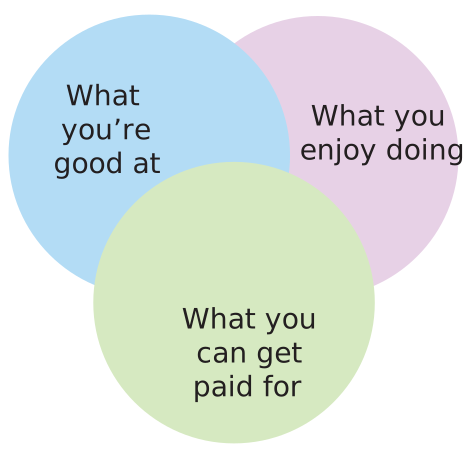
Because of the model from which the question is posed, a missing section of the diagram is "things that benefit yourself and others", because that is untethered from what you can capture financial profit from.
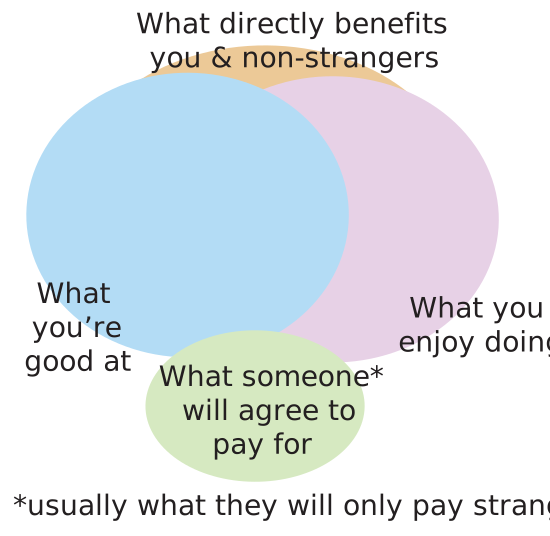
"What you can get paid for" fits the entire $128 trillion global economy. The non-overlapping part is mostly one-size-fits-all humanslop that I made to poor requirements-gathering because my employer didn't allow us to talk to the actual customers. Or crap from Amazon made by a company whose name is all consonants, that kind of thing. Some of the non-overlap is also bullshit jobs, rent-seeking, and financialization. The world pivots like a fulcrum on the people in the tiny overlap - bless you, oh captain my captain. The rest of the diagram shows you how much value most people are creating in their free time, often unacknowledged.
Each of us has a different diagram because this wide world contains an overwhelming variety of different people, for whom the "what they're good at" and "what they like doing" areas are all over the map. I contend that the "things that directy benefit you and non-strangers" area has stayed enormous. Over the decades, the "what you can get paid for" area has contracted, and drifted in a consistent direction farther away from many people's "what you're good at" area, and away from almost everyone's "what you like to do" area.
For whatever reason - call it their genotype, upbringing, socio-economic class, or some combination, I don't want to resolve that here - those for whom Church describes software development, writing, and other areas, having "died", had their "what you enjoy doing" area farther inside the "what the market will pay for" area than mine was. It drifted away from them. Now it's drifting away from the 9-to-5ers too.
Sure, there is an ever-expanding variety of newly-invented ways to make a living, which are, technically, different jobs. But have you noticed the dimensions along which they're contracting to become similar? Any features you and I actually care about. What if you want to be free from the mandatory performance of outward enthusiasm? Or to have more autonomy? Or to take less pay, to get more time off to follow other important pursuits?
What We Want To Do
If asked what they want to accomplish if they didn't have to earn an income, most people would say "musician", "artist", "actor" (or "dancer" or other performer), or "athlete". In my opinion, many people would put "stay at home parent" or "caretaker of my own elders and infirm relatives" if that were more socially acceptable. Most people want to entertain others, play, and relate to others, and most people's local environments are full of un-done tasks that need doing which don't need a specialist.
Caveat Magister's (AKA Ben Wachs) thought experiment on "Individuance" (the part above the paywall) suggests to me that different people's "what you like doing" areas might be scattering farther than ever before over the areas of the map. I think the "what you can get paid for" area is contracting and moving toward an edge, as the cycles I want to describe in this post compound on themselves.
Despite this, plenty of adults are okay enough with their jobs, as I have often been. Sometimes there's a compartmentalization: do things you care about for free, and things you don't care about for pay.
Lest you think I'm talking about a hobby, it's a calling. I've spent my entire adult life building venues in which to do interesting creative work to benefit yourself and each other; a science fiction convention, a maker space, a local regional Burn, and so on. The world needs far more of it than it has. Things people will pay a stranger for are handled extremely well in the current system, for which I'm grateful, but there are forms of work that no one will pay for, even if it's valuable, even if it's crucial, even if our starvation of it is eventually fatal. These are catastrophically neglected in favor of employment.
How We Want To Do It
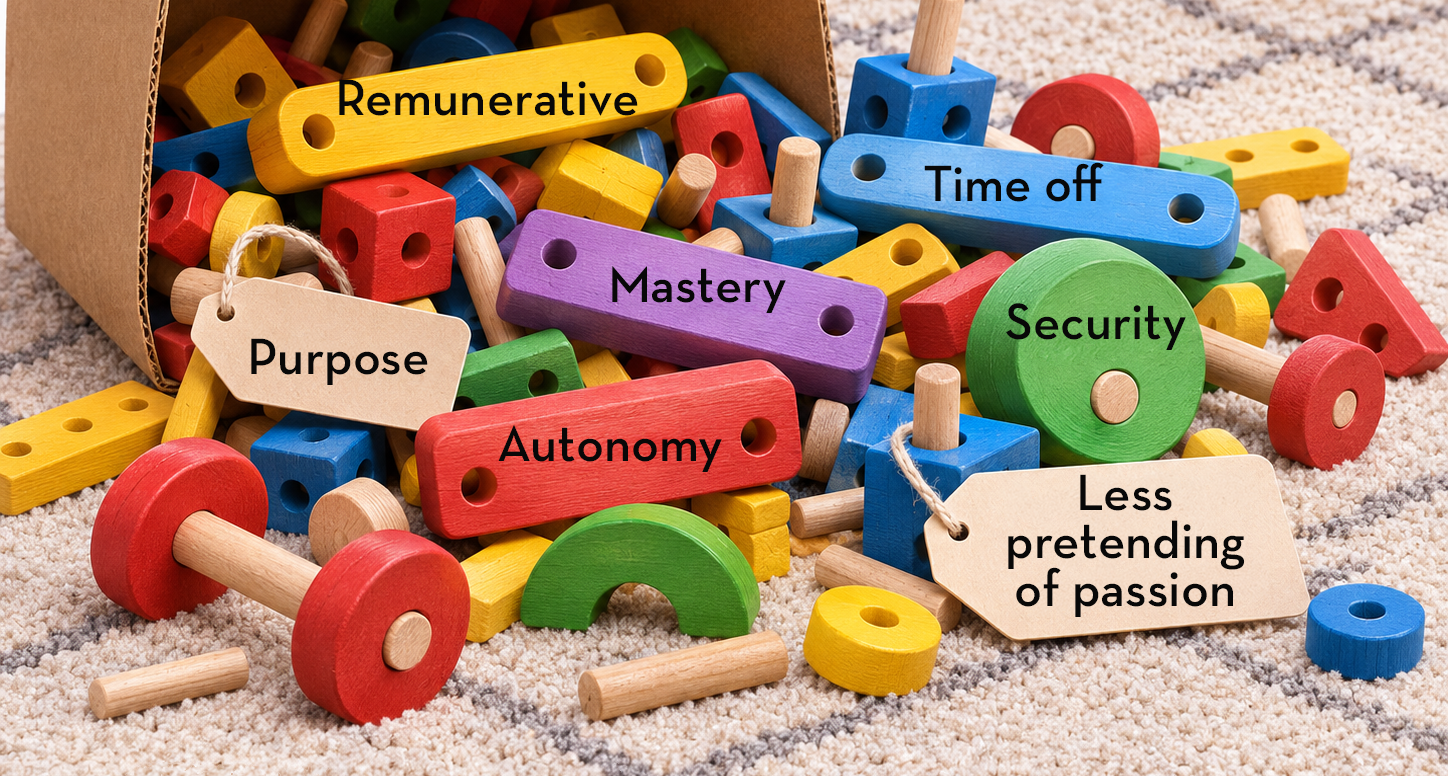
"What you want to do" is distinct from "what job tasks you enjoy doing" for a bunch of reasons specific to you. Depending on how picky you are about your life, build your own Venn diagram. We can't have everything we want, but different job markets allow different amounts of customization of our priorities and tradeoffs. It's decreasing.
It's not just "what you like doing". Can you do it in a way you like? Sure, change is creating unique new opportunities. But look at them. Most of those paths seem uncomfortably close to a reverse centaur.
I have close friends who sound completely different to me when we're at a local Burning Man than when I read them on LinkedIn, where it's as though some kind of entity speaks through their mouth. Sure, it's also their "self"... a side of them presented to be professional. And I'm sure they genuinely enjoy their jobs. But it puts me in mind of what's called "audience capture": somebody wants to be a YouTube creator. A few of them get to be one. Great. But they're not getting what they wanted out of it in the first place. They constantly have to contort their persona to what the platform rewards them for, and come to hate their own output. They have to actually transform into a different person. I don't mean personal growth in maturity and greater complexity of our capacities. I mean a self who you don't like better, but who is liked better by a pile of strangers, who are interchangeable to you, optimized at scale.
Am I being an authenticity snowflake? The "what you enjoy doing" part of the Venn diagram can be defined less restrictively. But you have to admit, that's not what most people have in mind by it. Church tells a story of three different phases, and in all of them, software was still being developed, but not matching all the purposes of different participants, regardless of how flexible the "self" is.
More and more opportunities involve selling not our time (as in unskilled labor) or selling our skill and labor (as in the skilled trades and technical work) but selling our passion. We are required not just to do what we're told, but to outwardly demonstrate enthusiasm. Many of us want to sell our labor, but offering to change ourselves to feel actual internal passion about whatever pays us to do so is taken to be selling who we are.
This doesn't have to be an abrupt personality change just from walking into a job interview. It can also set in over time, because we can become who we pretend to be. That can be for the best, when chosen, but wouldn't you rather that always be intentional? Whichever way of being a system rewards us for, we lean toward taking on, whether mindfully or not. I have an observation, for which I admit the only evidence I have is what I'm told by most of the therapists and patients of my acquaintance, and most of the therapy sessions I see recorded and put on YouTube: many patients are so over-socialized that they can no longer discern their intrinsic motivation from extrinsic.[1] Avoiding losing touch with intrinsic motivation requires constant cultivation through what I call a dissatisfaction practice combined with gratitude practice, as I have written before.
The 'God' Named 'Jobmarket'
Those who start and run businesses convince a pile of strangers to pay us money, and they give me a cut for doing things I wouldn't do unless I got paid. They get the biggest share of it because I don't want to do what they're doing. That system can be thought of, tongue-in-cheek, like a polytheistic type of "god", who some call Jobmarket.
Don't worry, I'm not going to speak of The Invisible Hand Of The Market as an inviolable law of nature. Quite the opposite. It's what John Nerst calls a caibus Compressed And Inaccurate But Useful Simplification. This post can be valuable without the more accurate version. If you'll indulge me in that, I'll use some scare-quotes, and call the caibus Jobmarket.
Most of us have a relationship to the "entity" we call Jobmarket, like my relationship to my housemate's cats, peacefully tolerating each other for transactional reasons and sometimes making demands the other party doesn't want. I've always been in a grudging transactional alliance with Jobmarket. In the same way that humans give their farm animals food and put them to work, I have relied on the Jobmarket as though it is a person who "assigns me" jobs.
But I love doing work that I feel a sense of reward and pride in, which I rarely can get paid for, so I'm kind of a workaholic on my personal projects in my free time. This is counted as having an unusually large amount of "leisure".
At this point, Jobmarket seems to no longer have jobs it wants to just "give" me. I must forage for remunerative labor. So I guess I need to learn from outdoor cats. (There's a friendly one on my block who I kind of admire for this.) I must stop waiting to be assigned work, and reluctantly become more entrepreneurial. I'm in a life stage where that's probably easier, but I still don't like my chances.
Practical Polytheism
Here we turn to Tyler Alterman's model of Practical Polytheism. He describes polytheism not as literal, but as a cognitive technology. The social ecologies he styles as "gods" are not people, in that they are less consistent (they're capricious). Where you or I are centralized in a more-or-less unitary self (in a limited sense, n.b. Buddhism), "gods" are distributed. They include the nation-state, pop culture, bureaucracy, globalization, and others.
- The Technic is whatever makes everything instrumentally measurable.
- Scenius is genius, except expressed by a group or "scene".
- Dionysus is whatever pushes us toward liberation, especially ecstasy.
The Four 'Gods'

In Code And Other Laws Of Cyberspace, Lawrence Lessig describes four ways for us to bring about desired collective behavior: markets, laws, social norms, and technologies. (It's really better described as "architecture" than "technology"). I'm not sure I want to rely entirely on markets. Church seems to agree with me that we need labor regulation.
See, the thing is, each of those four things can be usefully thought of as a type of entity. If you don't like thinking of laws, markets, norms, and architectures as four beings, think of them as four entire ecologies, each full of alternatives. Granted, these four divide up the world in a different way than Alterman's list above, but why can't there be sub-gods? Or compound gods? Super gods? Nested recursive gods? Backward-compatible with legacy gods? Gods that are polymorphic, or homomorphic, or isomorphic, or parametric, or noncommutative, or higher-order, or generic, or self-referential?
Object gods have meta gods
Up in their skies to smite 'em
And meta gods have meta gods,
And so ad infinitum. - Steven Kaas on Twitter
Just like my housemate's cats observe me doing my own thing to benefit myself for my own reasons, so do we observe laws, norms, technologies, and markets benefiting themselves for their own "reasons".[2]
An Example Of How To Apply This Frame
Church describes MBAs whose bad decisions can be disliked by those who work for them in two ways.
-
Sometimes bad decisions benefit managers individually. Even if they're aware of this (we are less likely to see things that either undermine our identity or our material advantage), they're not willing to sacrifice themselves for the good of a company. Unnecessary meetings. Leading an unwieldy number of subordinates. A strict in-the-office policy. Open plan offices where they can walk around constantly interrupting their software developers. These let them be visibly seen managing.
-
Management sometimes benefits for making decisions that are bad for labor, or for the world. This is a "god" named "the Invisible Hand". According to that political model, executives and managers who didn't make the decisions to maximize shareholder value were fired, and replaced with someone who would. Or if not, those who did had an advantage, often due to moral mazes.
If you want to say all we needed to do was have different and better people in charge, I'm very favorable to your political philosophy, but I also think a strategy of replacing bad MBAs with other MBAs who make better decisions is buggy. If you want to jeer and boo at them, you are correct, but all I'm saying is, why not seek change from those who you trust more? How about worker cooperatives?
Who Serves Whom?
If humanity has been domesticated by these systems, eventually we become surplus to capital. Things we do will still matter, and we'll certainly still need each other, especially when we honor or worship some of the "gods" Alterman lists. But Jobmarket can get what it wants with almost no humans. That distinction is lost in the present arrangement.
Alterman's writing on neo-polytheism seems to involve what individuals can gain, but not how humans can collectively steer these systems or ecologies of systems in order for more individuals to not be mostly-or-entirely owned by the four institutional "gods".
We have to honor Jobmarket to have food, lodging, and health care, but you can get those without honoring or worshiping Dionysus. And unfortunately it helps to not just honor Jobmarket (as I do), but to worship it (as some of my friends do).
LLMs seem, metaphorically, like an anthropomorphisation of the model I'm proposing. The world runs on aggregation systems that do distributed emergent things that no individual intended. There is now one of them that emerges from almost every text ever to be digitally recorded. And lo, it spake. I hear "AI takeover" as a smooth extension of anxieties such as "we need to stop corporations from producing negative externalities, but they seem to be better than humans at fighting back".
I'd like there to be a widespread adoption of the neo-polytheist metaphor: that humans are - or very nearly are - the pets or farm animals of laws, social norms, technologies, and markets, and that we are neglecting other gods. Decisions that are made from within that model are more likely to cause the Four Institutional Gods to steer each other, and tip the scales in humanity's favor.
One of the major alternatives to that metaphor is to complain about people and assign blame. Replace the bad people with other people. It's not wrong, in fact that's a crucial step, but without doing something with the four systems we end up back where we started, just with different blameworthy people in the same roles.
There are many ways to intervene. Examples include a Universal Basic Income, worker cooperatives, and participatory budgeting, or public employment programs for work we need that can't be paid for any other way, like climate change remediation. (This is distinct from a Jobs Guarantee, which could be just as bad as the current system.)
Consider how we would use the Four Gods to benefit worker cooperatives. Make it easier for employees to finance buyouts of their own company (Laws), make it sound more plausible (Norms), set up new architectures (Technology). We bring those three to bear on the fourth one (Markets).
My personal experience of many career professionals inclines me to generalize this to them, but I will leave my support for that stronger claim for another essay. ↩︎
I am not saying humans are no more intelligent than pets, or that these entities are "intelligent like humans" except more so. Neither is true. Cats are cats, humans are humans, and whatever these things are is something else. ↩︎