Highlights from "Competitive Sensemaking"

For years, I have been eagerly awaiting "Competitive Sensemaking: An Upgrade To Common Sense On Disagreement" by John Nerst. (print, ebook, non-Amazon epub) He spent four years writing it instead of posting to his blog, "Everything Studies", which is mostly about his term "erisology", the study of disagreement.
I just finished reading it. Throughout reading the book, I've had conversations in my life in which I noticed my approaches and habits already shifting around the tools he offers in it. This book has joined a very short list of books that are the most personally significant and useful to me.
No doubt I'll refer to it often in the future. I'm going to spend the next period of my life exploring some connections he has made extremely visible. In the meantime, I'll just past the excerpts which, if I had read it on paper, I might have highlighted, circled, or underlined.
My own comments will be in indented blocks like this.
Having to be explicit about the underlying assumptions, interests, and priorities that you usually just take for granted, and accurately inferring the corresponding assumptions, interests, and priorities that others in turn take for granted, is a tall order.
In the current environment, dialogue between coherent, well-defined subjects is less the norm than musing, yelling or venting straight into a shapeless, cacophonic whirlwind where you’re at once addressing yourself, no-one in particular, and partially real, partially imagined versions of loosely defined groups of friends and enemies. In the culture war trenches we don’t engage with others as people per se, but them reduced to avatars of constructed factions: “you people are like this”, “another one of ‘you’ said that”, “this is what your side always say” and so forth. We cast the other as a representative without their consent or even knowledge, making them play bit parts in a story with us as the hero. And they do the same to us.
Somewhere to feel at home is good, expecting to feel completely at home everywhere in society is not, because it cannot be true for everyone at the same time.
From a chapter about a term the author introduced, "cat coupling":
John Nerst's original blog posts about cat couplings are here and here.
“Pessimism has its downsides, but is still preferable to naive optimism.” It’s the ambiguity; once that is removed it stops working. There’s a broad interpretation that says what you want (optimism is worse than pessimism because it is naive), and a narrow interpretation that’s easily defensible (optimism is worse than pessimism when it is naive).
...the claim exists in an interpretive “superposition” between two states like the famous Schrödinger’s Cat—hence I call it a “cat coupling”. In the original thought experiment illustrating a phenomenon in quantum mechanics where things are undetermined until they are measured, a cat in a box is in a state of both living and dead at the same time until we decide to open the box and look. In the same way, a cat coupling is in a state of two combined interpretations until clarified (which it almost never is).
By making a “type” of person (like doctors-who-fulfill-ideal-criteria) and at once using it for a comparison, you’re assuming it’s a valid construct, and by doing that you’re treating the group of doctors-who-don’t-fulfill-these-criteria as if they don’t exist. You don’t outright deny their existence, but you present reality from an angle where they can’t be seen, like the far side of the moon. In fact, every kind-with-attribute construct, every type, has this quality of there being a hidden far side of kind-without-attribute that’s rounded off to nothing and forgotten.
...how about a description of a house party as full of “introverted weirdos”, a gaming club of “rude nerds” or a workplace of “hysterical women”? Or a forum “infested with argumentative libertarians”? Nothing incorrect about those phrases per se, but it gives off just a little whiff of intent, doesn’t it? Disregard at the very least. It could have been just “weirdos”, “assholes” or “hysterical (or argumentative) people” or some other formulation, if you’d had the slightest desire to avoid tarring certain groups of people in the process. Here, take some more spotted items as exercises: “socialist hellhole”, “creepy middle-aged men”, “out-of-touch elites”, “contrarian bullshit”, “90 percent male cesspool”, “dumb jocks”, and “the shrieking harpy Left”.
A word on prefixes: when we disapprove of a type being articulated or referenced we put “stereo-“ in front of it. When we approve we go without prefix or try “arche-“.
From a chapter about the rhetorical move called motte-and-bailey:
...cat couplings are best understood as an exercise in constructing and rearticulating types, but can also be a way to say two things at once and exploit the ambiguity between them: one ironclad but trivial, and one impactful but indefensible (if made explicit). The latter is a nutshell version of the idea first put forth by the philosopher Nicholas Shackel in his 2005 article The Vacuity of Postmodernist Methodology, and then catapulted to internet fame in the mid-2010s: motte-and-bailey doctrines. A motte-and-bailey is a two-part medieval castle structure with a cramped fortification (the motte) surrounded by a village with fertile, valuable land (the bailey). The bailey is difficult to defend, so when attackers show up, the villagers retreat to the motte and shoot arrows at them until they go away. Then they come back out to work the land again. Shackel suggests some philosophical positions work the same way. His example is relativist and anti-rational views in postmodernism, whose proponents like to make bold, radical claims but back down to assert only mild, common-sense versions when challenged. Left alone again, they revert to acting like the radical versions are true. “Reality is socially constructed” lends itself to this, as we've seen. So do “sex is not binary” and “there's a war on Christmas”.
John Nerst wrote an article, Postmodernism And The Pomoid Cluster, which helps you de-confuse yourself on several of the baffling-but-important terms we hear bandied about.
From a chapter about how most things are partially "fact" and partially "slogan":
...we default to thinking of words as tools for communicating information. But words are more than tools, they are also art supplies, with which we express and induce feelings and impressions, and they are weapons. They cast judgment, invite sentiments, and shape the way we see the world; what seems real and what doesn’t, what we notice and what we don’t, what we celebrate and what we condemn.
Compounds of “matters of fact” and “matters of value” become “matters of model”, irreducibly over how to represent reality.
The best tip I’ve got for now is to substitute “counts as” for “is” as often as you can and see how that changes things. It’s been my habit for some time, and it has turned out to be surprisingly powerful. It steers your mind away from abstruse philosophical mudding about essences and towards what the issue is really about: how we’re going to treat something. And as part of that, it invites the question of which specific context we’re discussing, which can help to dislodge mistaken essentialism.
From a chapter about "reading the room":
Not to think things through on your own, not to reason, but to navigate beliefs socially. “Accept the standard and stop making trouble” is not a rare sentiment, and that implies that ideas in that position as standard, i.e. with “a spot in the room” are at an advantage. With that, we can reframe discourse as various actors trying to put stuff in the room or take them out. The nice thing about getting your beliefs into the room is that you don’t have to argue for them.
Even if inconsequential on its own, a symbolic victory by our enemies is a display of power, demonstrating that they have the capability to dictate standards. We correctly perceive it as a threat.
Some words’ entire function is to suggest that some part of shared social reality is an illegitimate artifice, like a usurper to the throne. Compare marginalized, normalized, sexualized, othered, and glorified, with marginal, normal, sexual, other, and glorious...
Social coordination, not truth-seeking, is the primary function of professing beliefs, and of listening to others profess theirs.
It’s no surprise that things meant to establish specific shared realities by which I feel threatened and excluded, like group prayer or the ritual sharing of preferred pronouns, creep me out. Even what I broadly agree with feels unsettling when the vibe suggests dissent is unwelcome—when the room sternly demands to be read.
It’s a pattern to look out for, all across the political spectrum: pushing for or enacting changes to policy or social norms and then accusing others of politicizing when they push back. “Culture war” is sometimes used like this as well, as in “the others are engaging in culture warring when they oppose the implementation of my side’s obviously correct beliefs”.
From a chapter about partial narratives creating artificial clarity:
-
removing noise and irrelevancies to get a cleaner, clearer signal feels like apprehending a purer truth,
-
partial narratives select a particular point of view from which to make sense and then ignore everything that doesn’t fit.
Putting the two together implies that partial narratives are crack cocaine to intelligent minds.
...the more one simplified, generalized, and narrativized, the more we disagreed. When details were worked out and more specifics introduced, our disagreements softened.
All the cross-references to supporting beliefs, facts, events, and experiences can’t be articulated or communicated, and expressing yourself in those circumstances with the shorthand and emotional force appropriate from within the narrative comes across as hyperbolic and unhinged from outside it.
Ideologues are those convinced that these stories we internalize are the truth itself. Starting to perceive abstractions directly is, to them, not a corruption or a double-edged sword, but consciousness-raising. Taking them on isn’t incorporating another device into your toolbox but a transformation into an enlightened being. It might be called being “conscious” but also “red-pilled” or—from back when the word was a self-descriptor more than a term of abuse—“woke” (awakened). The mechanism is the same.
From a chapter about combining narratives and picking which one of them is the main narrative and which one the exception or correction to it:
This main-plus-corrective model can make sense of a lot of things. For one, it gives us a new way to characterize zealots or ideologues: they lack correctives. And groupthink is a social dynamic where voicing correctives is taboo.
...we don’t notice unstated standards when they correspond to our own views (“they’re not assumptions, it’s just the way things are”). When they don’t, however, we do notice, so we feel there are more of those cases.
...most argumentation is corrective, in that it says something the speaker thinks is underacknowledged. Thus it can only be properly understood given knowledge of how well appreciated the speaker thinks various things already are.
From a chapter on how people's inner experience is far more different than we usually think:
If you do think in words it makes sense to think of available vocabulary as much more strongly determining the thoughts we can have. I’ve stressed the importance of vocabulary myself, but I see its significance as mainly social, not psychological. It determines what we can effectively communicate, but not what we can think.
...would it change my philosophical beliefs if I could have the inner experience of a believer in new age spirituality, with “energies” and “auras” and whatnot? Experiencing spontaneous voices and images might make entirely different things feel plausible, compared to me thinking mostly in Hurlburt’s unsymbolized abstractions. Some do report changing their beliefs after experimenting with psychedelics.
From a chapter on what I would personally call "over-socialization":
Throughout this chapter, I thought about Kegan's stages of adult development on almost every page. It sounds like a description of stage three). And yet, taking this book's advice into account, I recognize it's one frame that can be put on it, and I'm likely to be over-applying it.
The idea that you can not know, not be quite aware, or just not pay attention to what kind of food you like is wild. I’m obviously aware of fashions and status and social expectations, but I’ve never confused them for actual enjoyment. But perhaps doing so is more normal than I think.
Is it in fact normal, even typical, to experience social reality as solid enough to be indistinguishable from physical fact?
...the all-too-common error of thinking that everyone with different preferences must be duped or brainwashed into them (because people can’t really be different).
We get so confused, frustrated, and angry when we assume others are like us but stubbornly and inexplicably fail to conform to how we expect them to then act.
From a chapter on unstated libertarian and communalist intuitions around responsibility, leading to talking past each other without realizing it:
Note: This chapter is about how intuitions might be influenced by personality and other traits, and how to communicate with each other better, not to convince the reader of one of the sides. Both are unspoken chaotic intuitions and not the same as the worked-out ideologies with which they are sometimes associated.
Given that politics are about relationships between citizens in a society, it’s likely that how you relate to others has bearing on which politics you prefer.
When modeling others is far more cognitively and emotionally draining than performing specific duties, blanket expectations to live your life taking everyone else’s unarticulated needs and wants into account comes across as an overbearing, fundamentally aggressive demand. Extending this disposition to politics gets you a dislike of the idea that we, by default, have a bunch of broad, implicit, and unarticulated obligations to everyone else. The mere existence of such potentialities triggers a stress response.
What you do tend to like, politically, is rights. Rights cut through all the complexity that comes with having to consider fellow citizens’ interests. They are, by design, “no questions asked”. As part of a close-knit community, you’re supposed to weigh all concerns back and forth—“consult the opinion of the group”—before you know whether you can do something. With rights, however, that gets short-circuited. If you have a right to do something, you don’t need to perform any social labor to know if it’s ok, nor do you have to justify yourself to anyone.
To which user @zippkode chips in with: That’s the disconnect, though. They think that an obligation to do something stems from culpability. If they aren’t responsible for the problem, they aren’t responsible for fixing it. This is a good example of a “scissor”—a controversial claim that appears uncontroversially right or wrong to each side. Here, zippkode finds the libertarian intuition so obviously wrong that just articulating it counts as refutation. To the other side, however, it’s as if someone had said “you see, these people are crazy enough to think things fall down instead of up and that bears shit in the woods”. Given the libertarian model of responsibility—its paradigm, if you will—someone bringing up historical crimes to justify an obligation on you logically implies blaming you for those crimes (a Kuhn distortion), because only that could justify such an obligation.
Another time the intuitions fire in opposite directions is when people have special needs. Whether it’s physical disabilities, “neurodivergence”, special diets, or whatever, such issues create costs, and the question is who is expected to bear them. Do you have to kindly ask others to take on part of them and accommodate you, and be grateful for it, as if you were, by default, on the hook for the bill yourself? Or are we all part of an informal, mandatory insurance system for any problem befalling you that isn’t your fault, meaning others must accommodate you without complaint or thanks for doing the bare minimum?
This chapter shows a framing in which libertarian intuitions result from things like "stress responses", which is a victimhood and sympathy framing more likely to fit communitarian intuitions. Learning about other people can be great for speaking their language and using their frame, and also explaining one's own language and frame in such a way as to help them get out of using only their own. Both sets of intuitions can be described as "neurodivergences" within the communitarian frame. Each can describe the other (mistakenly, in my view) as belonging to a supposed neurotypical majority. As I have said elsewhere, there is no "one true neurodivergence", and the concept of supposed "neurotypicals" breaks down.
The struggle between communitarian and libertarian intuitions is an emergent result of human nature in large, interconnected civilizations. They inform but do not entirely define left and right (again, intuitions, not full ideologies). I only discuss this to suggest that psychological predilections can make us like or dislike different aspects of human relations, which in turn affects our preferred coalitions, non-negotiable values, and implicit assumptions about what’s good, right, and important. A first step in negotiating them more effectively is bringing them to the surface as psychological features and interpretive mental schemas. Just making them part of our common lexicon would be tremendously helpful.
From a chapter about dichotomies, and how everything can be divided into multiple potential black-and-white dichotomies:
...it is so counter to our nature to think in gradual terms that the way we do it when we have to is by putting different absolutes in hierarchical order. Rather than remember a number between 0 and 1 we prefer to think “0, but also 1”, or vice versa.
From a chapter about our inner Figurehead (the conscious mind), the inner Analyst (the ability to think through something step-by-step), and our inner Prince (motivated reasoning and self-deception):
When we want to, we all understand that a single counterexample doesn’t disprove a pattern, that a single example doesn’t prove one, that it’s not fair to smear a whole group by pointing to a few bad apples, or that it’s hypocritical to exaggerate the importance of one thing and minimize that of another.
It’s a great achievement of civilization that fighting has largely been replaced by arguing since modernity and democracy, but maybe it’s caused some unintended weirdness: we were never meant to argue with the enemy.
For collectives, their ability to reason depends on their norms and their internal composition. While people are not designed to be individually rational in a social setting, we are designed to take part in a rational process. Collective rationality can handle individual bias as long as there is diversity of opinion that is accepted and respected, and disagreement is functional, i.e. that parties have good enough erisological competence to manage the diversity without failing to communicate. If we’re low on ideological and temperamental diversity, the only choice is to force a community to replicate the strict, individual-style reasoning Mercier and Sperber called “The Dogma”. That is, to maintain collective rationality by ruthlessly calling out motivated cognition and cronyism in each other, and create a culture where contrarianism, pedantry, and playing devil’s advocate are valued for their own sake. This is much harder than ideological diversity, but a community that is neither ideologically diverse nor saturated with such quasi-autistic behavioral norms will not have functioning collective reasoning.
There is no natural law or principle whatsoever guaranteeing that these two types of judgement, made from opposite ends, will agree with each other.
From a chapter about a concept the author popularized, "decoupling":
When discussing labels back in chapter 10, we saw that they do on the one hand refer to reality (“does this label accurately reflect the nature of what we apply it to?”) and on the other, to morality (“are the consequences of applying this label good?”), and that these are separate questions. To repeat once again because it’s so important: There is no natural law or principle whatsoever guaranteeing that these two types of judgement, made from opposite ends, will agree with each other. It is accurate to refer to some people as “ugly” or “stupid”, but we may justifiably think it’s morally wrong to do so (and also that it’s a moral problem that these attributes tend to come with worse life outcomes). In the same vein we might understand that some stereotypes are statistically accurate but also disapprove of applying this knowledge to individuals.
...in the spring of 2018 I wrote an article that went, for some meaning of the word appropriate for a small blog, “viral”. The 9000+ word autopsy of a spat between public intellectuals Sam Harris and Ezra Klein grew my audience tenfold overnight, and the term “decoupling” slipped loose.
...their disagreement was, in essence, over whether [Charles] Murray’s take on the scientific evidence was legitimate, and by extension whether the issue belongs under the jurisdiction of science or of politics—two magisteria with big differences in how claims are understood and evaluated.
Getting “unhooked” from the real world by excessive cognitive decoupling risks damaging our motivational system and capacity to make appropriate, timely decisions...
The main thesis of What Intelligence Tests Miss [by Keith Stanovich] is that tests only measure the capacity of our algorithmic mind, not our proclivity to use it, which is his definition of “rationality”.
Cognitive decoupling (or “classical reasoning” in M&S’s parlance) is thus a small act of hubris: “I can actually understand this, using the power of my thought, instead of relying on socially acquired and transmitted rules-of-thumb, because I, unlike others before and beside me, sniff, have the capability.” This is why those who decouple the most, like physicists, mathematicians, and engineers, have a reputation for intellectual arrogance.
To such a “coupler”, decouplers trying to fence off any unwanted implications and pretend they don’t exist looks bizarre and disingenuous. You don’t get to remove associations that are an inherent part of a concept’s meaning by decree!
Different people find it differently easy and enjoyable to think in formal logical vs. social and emotional terms, and therefore do it more or less eagerly.
Decoupling is real and significant, but it’s not just an ability, it’s not always the right thing to do, it’s not simply determined by an immutable characteristic, and it has limited value for explaining where people land on controversial issues. Even so, it helps us to recognize when disagreements are made more complicated by an ancillary disagreement over whether decoupling is appropriate.
From a chapter on unspoken agreements to not talk about certain things:
Decoupling as an approach to collective reasoning has something else in common with decoupling in individual thought: trust in the process. Decoupling means you believe we have the capacity and wisdom to master the issue at hand. If we assume this, there is, notably, no such thing as a “dangerous idea”. A dangerous idea would be one that is bad, yet we might adopt. This is a contradiction in terms since we can’t both be justifiably confident an idea is bad and believe rational evaluation could have us adopt it. I used to think exactly this way, and this was my reason: to not trust public debate to come to the right conclusion is so cynical and condescending towards the intelligence of the average person that it could be ruled out on moral grounds. Take a few seconds to appreciate the irony.
Accepting what someone says only in a particular narrow meaning and agreeing to disregard all wider associations is necessary to communicate on delicate and complex issues, but it requires good will, which can be exploited. As frustrating as it might be to the devoted decoupler, refusing to decouple is a rational and appropriate stance in low-trust situations, when what you say can be taken out of context, or when there’s an audience.
If either side in a disagreement tries, or is perceived to be trying, to use only one partial meaning as a stand in for the whole—that is, pretend that either moral legitimacy or factual legitimacy is synonymous with legitimacy generally—the other will respond, a controversy will result, and “who started it” will be a major, yet unacknowledged, part of it.
From a chapter on what we are doing when we use words:
I’ve heard it said that “nerds think of communication as submitting their personal thoughts for peer-review”.
It’s either the responsibility of listeners to not read things into it that aren’t necessarily there, or it’s the responsibility of speakers to not say anything that listeners might read bad things into.
There’s some of both. How much depends on the specifics of each instance.
This seems to be a genuine psychological difference, because I do hear people saying about music/movies/books that they have real difficulty to see something as “just” a work of art and not judge it by their opinion of the creator.
Often the experience of a work is not internal at all; it’s experienced as the same thing as the collective experience of praising or criticizing someone.
I suspect that in high-coupling contexts like PR, arts, and politics, the idea that vibes can be “wrong” is not seriously entertained at all. Note how this, for better or worse, mirrors “therapy culture” and the idea that feelings must always be validated.
If we ask ourselves how decoupling aligns with communitarian or libertarian intuitions the answer feels obvious: “Decouplers” have the libertarian intuition, viewing people, like concepts, as fundamentally separate, with obligations to others being opt-in, based on affirmative consent, just like links between concepts only count when agreed on. They also find no problem treating “this is a good person” and “this person makes a valuable contribution to the group” as separate questions. “Couplers”, again, not only think of all of us as by default part of a system of obligations, or feel that “good properties” should go together, but are also more likely to think of duties as broader than just executing a narrow, well-defined task. Police aren’t just supposed to catch criminals, but must fight the root causes of crime (and preferably other social ills too!), teachers not only teach, but support students well-being and self-actualization, armed forces not only defend their country, but contribute to a just world, and, last but not least, scientists don’t just study reality but work for the improvement of society.
The thesis of the whole book, that we should be able to take in and comprehend belief systems that are not our own without necessarily adopting them, is in fact that a particular kind of decoupling is desirable.
From the coda, about a synthetic meta-ideology (concerning the process, not the conclusions):
People are different. We obviously act differently, but differences don’t start with the decision to act. We act differently because we perceive, parse, think, feel, want, need, and judge differently. There is humanity in us all, but we underestimate how different the insides of other people’s heads are to our own. Other minds are foreign countries.
The best of scientific materialism and social constructionism are compatible, in principle, once you accept that what constructionists insist on calling “reality” is a shared model and not reality itself.
Passions choose our heading; they are not to micromanage. On the other hand, the “couplers” are right that we don’t speak in a vacuum, and that normal human communication is not an exercise in formal logic.
The social function of public debate is to evaluate ideas accurately and fairly, in other words: to do what our individual minds are naturally bad at.
Liberalism is the acknowledgement that contemporary societies are trading zones, and that attempts at enforcing a single dominant shared reality are inescapably authoritarian. Paradoxically, this requires insisting on common ground, but on a level above the specific. It means having to agree on processes rather than outcomes, on rules rather than teams.
Being specific about the tactics at the Prince’s disposal arms the Figurehead (the part of us that really believes in our moral virtue), making us more likely to question what we’re told. Relegated to ceremonial duties by default, we are still the rightful monarchs, and we can make the decision to assert power and rule with wisdom and integrity, or we can keep standing on the balcony, waving at the crowd, unwittingly providing cover for the dirty operations of state.
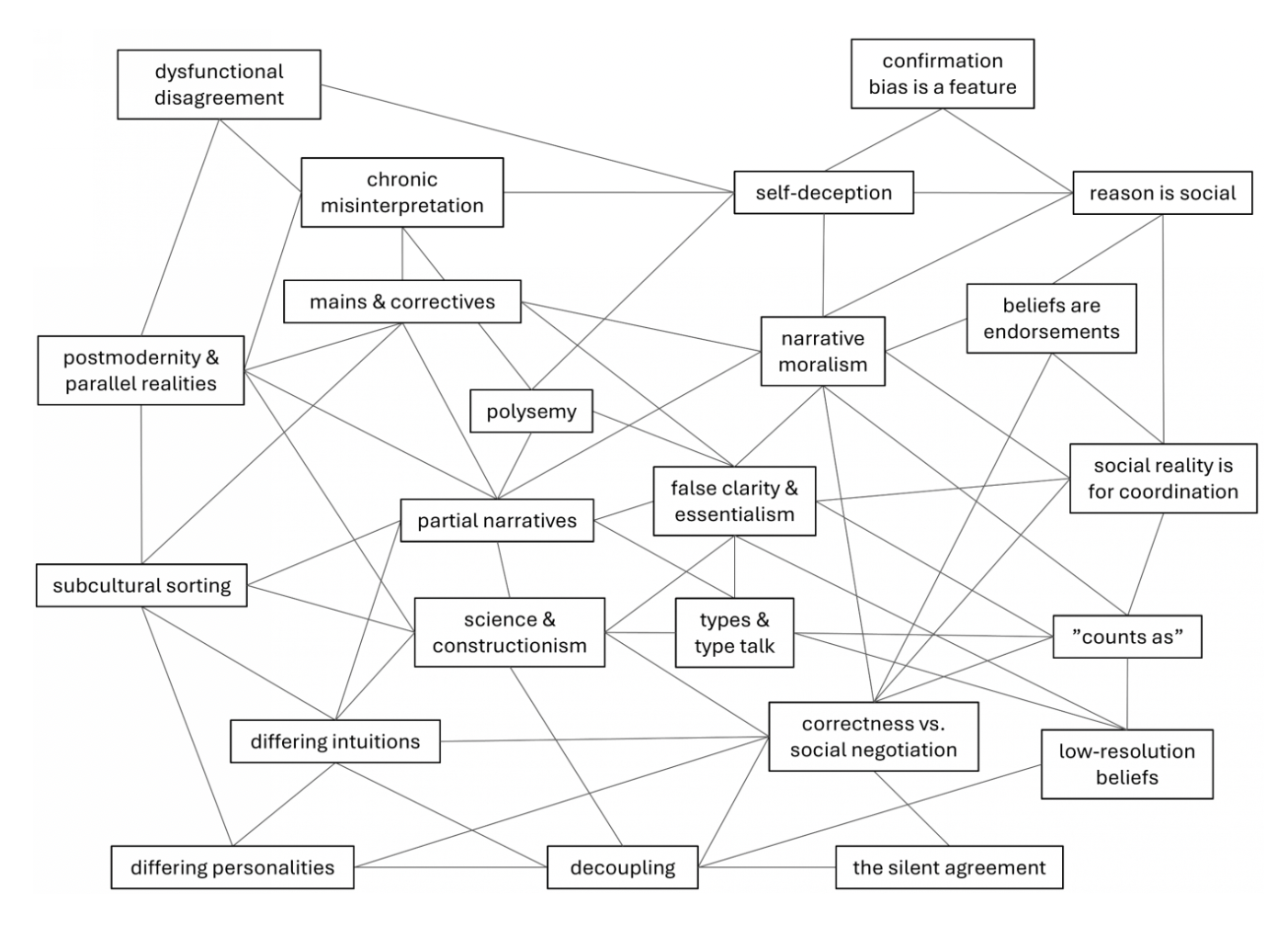
...public discourse has less and less of the two features characteristic of well-functioning disagreements. The first, characteristic of academics, is well-defined, agreed-upon concepts and terms. The second, characteristic of friends and family, is the mutual respect required to consider each other’s interests to be legitimate. We can maybe limp by with one of the two, but not with zero. To repair the damage, we must become literate in each other’s belief systems, and aware of how values and intuitions are rooted in personality and experiences. That means internalizing, thoroughly, that our model of reality, including of other people, is not reality itself.